


 RECOVERY PACK
 Yanga
Yanga Loyalty program
 Group trainings
 Personal trainings
 HYROX trainings
 Intro trainings
 Friends & Family Invites
 All trainers
 Business
 Mision and values
 Rules
Rules All clubs
 Club occupancy
 News
News Career
HYROX endurance competition – achievable for everyone. How to prepare?
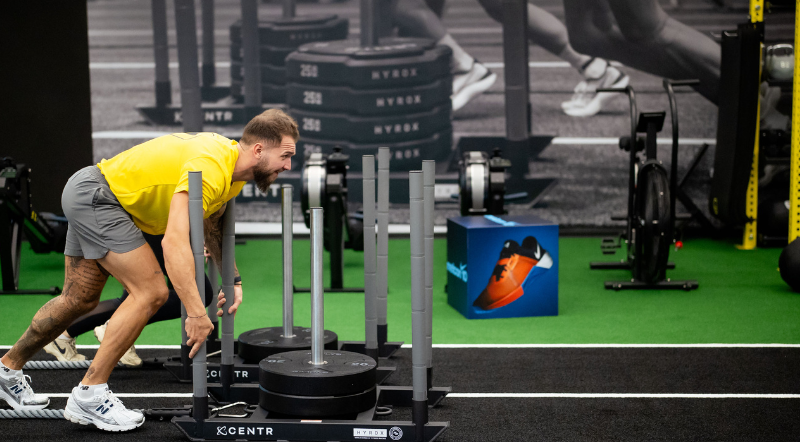
HYROX emerged as a standardized fitness competition format that combines running (a classic test of endurance) with functional exercises (a test of strength). With 8 running segments of 1 km each and 8 functional stations, the format is clear and straightforward, yet HYROX competitions require exceptional endurance.
We asked LEMON GYM HYROX coach Tomas Kizelis how to prepare for it.

It seems there’s no shortage of competition formats in the fitness world. So what makes HYROX different from, for example, the CrossFit Games or Spartan Race?
The essence of HYROX is “fitness racing” – a standardized strength and endurance competition format. The structure is always the same: 8 km of running (in 1 km segments) + 8 functional workouts (sled push, sled pull, SkiErg machine, rowing, burpee broad jumps, farmers carry, weighted lunges, and wall balls). The format is identical worldwide – like a marathon, whether you run in Hamburg or London, you do the same thing.
The CrossFit Games is more like a fitness decathlon, combining a bit of everything – gymnastics, weightlifting – and the workouts constantly change. Meanwhile, the Spartan Race is more of an adventure race in nature with various obstacles.
If HYROX is called a fitness marathon, does that mean it is one of the ultimate tests of endurance? Is everyone’s heart ready for such a challenge?
A steady 42 km marathon requires monotonous aerobic endurance. Although running is the foundation of HYROX, and 8 km is significant, it more closely resembles interval training, since functional movements are performed between runs. You need to get used to running under fatigue. This means you don’t need extremely high-level running preparation alone – muscular strength endurance is far more important.
As with any challenge, the biggest risk arises when someone has no physical preparation and suddenly enters a HYROX competition without training. The competition itself is achievable for many, especially if preparation is gradual and the right category is chosen. Every heart has its limits, but HYROX is not a sprint from start to finish. Most participants complete it in 1–2 hours at a “moderately high” cardio intensity. If a person is at least somewhat active (running, strength training), their cardiovascular system is usually sufficiently prepared.
You mentioned different competition categories. What are they and how do they differ?
The competition takes place in four categories – Open, Pro, Doubles, and Relay.
Open – an individual category for everyone, from beginners to advanced athletes. The weights are lighter than in the Pro category. Suitable for those trying it for the first time or not aiming for elite results.
Pro – an individual advanced category. The same exercises, but with significantly heavier weights. This is where top-level athletes compete for qualification to the HYROX World Championships.
Doubles – two participants (men’s, women’s, or mixed teams). Both must complete the runs together (8×1 km), while the functional exercises can be split between them (e.g., one does 30 burpee jumps, the other 50). Weights are at Open level.
Relay – a team of four. Each participant completes only 2 runs and 2 exercises. Weights are also at Open level. This format is ideal for team-oriented participants or those not yet ready to complete the full race individually.
Both Open and Pro categories are divided into male and female age groups (e.g., 16–24, 25–29, 30–34, 35–39, … up to 70+).
The best Pro athletes from each age group qualify for the HYROX World Championships at the end of the season.
It seems that enthusiasm alone is not enough – how does a fitness beginner become a competition participant?
Motivation alone is definitely not enough – HYROX is not just a “fun challenge.” It requires consistent physical, technical, and tactical preparation. It’s important to assess your abilities: can you run at least 3–5 km without stopping? Can you perform basic movements like squats, push-ups, or deadlifts with moderate weight? Functional mobility in the ankles, shoulders, and hips is also essential for safe movement. If any area is lacking, it should be improved before starting a serious HYROX plan.

Here are possible preparation stages:
- Base phase (4–6 weeks): build endurance, strength, and movement technique.
- Specific phase (4–6 weeks): introduce HYROX-specific exercises like sled push/pull, burpee broad jumps, and carries.
- Competition simulation (2–3 weeks): perform the full HYROX format (8×1 km runs + 8 exercises), possibly with lighter weights.
It’s very important to learn proper technique, plan your race strategy, control breathing, and maintain a steady pace to conserve energy. For running, practicing “brick runs” (running after exercises) is essential so the body adapts to fatigue.
All exercises require not only physical but also psychological endurance – how can you prepare for that?
HYROX competitions last 60-120 minutes, which is a major stress on the body. Good sleep, planned recovery weeks, and proper nutrition are essential. Even with good physical fitness, without psychological preparation you may “hit a wall” mid-race. It’s important to simulate competition stress during training: noise, timing, and a bit of chaos. Psychologically, it’s easier to break the race into smaller goals – each run and exercise becomes a mini-task. Mental strategies help control thoughts during fatigue, such as repeating: “I can get through this station” or “Just one more, then rest”. Strategy is crucial – HYROX is not won by the strongest, but by those who can maintain a steady pace without entering the “red zone” (maximum heart rate zone). Weekly small challenges (like increasing pace or weight) help turn training into “mini competitions” and build tolerance to discomfort.
Is attending HYROX classes enough during preparation? What should be improved to perform well across all disciplines?
HYROX training is important, but it’s only one part of the program. It’s not enough on its own because the format requires well-rounded fitness: endurance, strength, technique, and tactical skills. HYROX classes simulate competition but don’t always ensure strength progression, so separate strength sessions are necessary. Improving running also requires interval training (e.g., 8×500 m with 90 s rest) and tempo runs (5–6 km faster than race pace). Technical refinement of each exercise is essential. Interval-style workouts (30–60 seconds of work) are very effective, as they reflect the demands of HYROX. Once a week, a partial simulation (e.g., 4 km run + 4 exercises) is recommended to practice transitions between running and exercises.
Training should be periodized to develop all aspects: endurance, strength, technique, and mental preparation. To build these skills and learn proper strategies and techniques with certified coaches, you’re invited to the dedicated HYROX space at the new LEMON GYM in AKROPOLIS.
To sum up, who would you recommend this format to, and who would you invite to HYROX training at new LEMON GYM Akropolis club?
HYROX is ideal for active individuals who want to test their endurance and strength in a standardized yet achievable format. Even first-time participants can have a great experience if they prepare properly. It’s also recommended for gym-goers who want to test their strength endurance in real competition, as well as running enthusiasts looking to go beyond simply logging miles. The Relay and Doubles categories are perfect for those who want to compete with friends or family.